
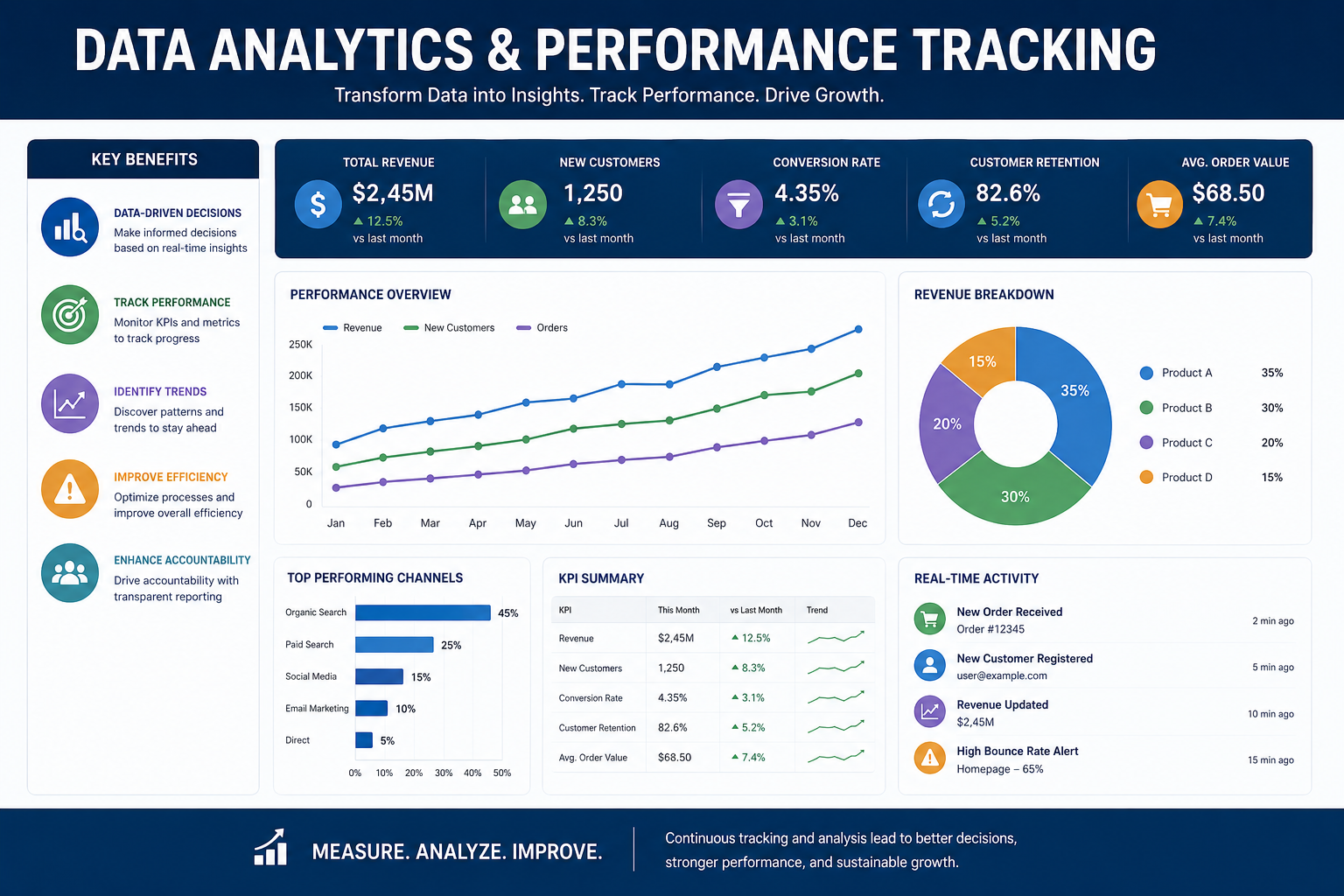
In today’s highly competitive digital landscape, businesses can no longer rely on assumptions when making marketing decisions. Success comes from understanding customer behavior, measuring campaign performance, and using real data to guide every strategy. This is where Data Analytics and Performance Tracking become essential.
Data analytics transforms raw information into valuable insights, helping businesses understand what works, what doesn’t, and where opportunities for growth exist. By tracking key performance metrics, organizations can optimize their marketing efforts, improve customer experiences, and maximize their return on investment (ROI).
Why Data Analytics Matters in Modern Marketing
Every interaction a customer has with your brand creates data. From website visits and social media engagement to email opens and online purchases, each action provides valuable information about customer preferences and behavior.
Businesses that effectively analyze this data gain a competitive advantage because they can:
- Understand customer needs and interests
- Identify successful marketing channels
- Improve campaign performance
- Increase conversion rates
- Reduce unnecessary marketing expenses
- Make informed business decisions
- Enhance customer satisfaction
Instead of guessing what customers want, data analytics provides clear answers backed by measurable evidence.
Turning Data Into Actionable Insights
Collecting data is only the first step. The real value comes from interpreting that information and transforming it into actionable strategies.
For example, if website analytics reveal that visitors spend more time reading specific blog topics, businesses can create more content around those subjects. Similarly, if social media campaigns generate higher engagement than email campaigns, marketing resources can be allocated more effectively.
Data-driven decision-making helps businesses focus on activities that deliver the greatest impact while eliminating strategies that produce minimal results.
Key Metrics Every Business Should Track
Successful performance tracking begins with monitoring the right metrics. These indicators provide a comprehensive view of business and marketing performance.
Website Traffic
Website traffic measures the number of visitors accessing your website. Tracking traffic sources helps businesses understand where audiences are coming from, whether through search engines, social media, paid advertisements, or direct visits.
Increased traffic often indicates growing brand awareness and market reach.
Conversion Rate
A conversion occurs when a visitor completes a desired action, such as making a purchase, filling out a contact form, or subscribing to a newsletter.
Tracking conversion rates helps businesses evaluate how effectively their website and marketing campaigns turn visitors into customers.
Customer Acquisition Cost (CAC)
Customer Acquisition Cost measures the amount spent to acquire a new customer.
By monitoring CAC, businesses can determine whether their marketing investments are generating profitable results and identify opportunities to reduce acquisition expenses.
Return on Investment (ROI)
ROI is one of the most important metrics in digital marketing.
It measures the profitability of marketing campaigns by comparing the revenue generated against the amount invested. High ROI indicates that marketing efforts are producing valuable returns and contributing to business growth.
Customer Retention Rate
Acquiring customers is important, but retaining them is equally valuable.
Customer retention metrics help businesses understand how effectively they maintain long-term relationships with existing customers, leading to increased loyalty and repeat purchases.
1.The Role of Analytics in Customer Understanding
Modern consumers interact with brands across multiple channels, including websites, social media platforms, mobile applications, and email campaigns.
Analytics tools provide a complete view of the customer journey, helping businesses understand:
- Customer interests
- Buying behavior
- Preferred communication channels
- Content preferences
- Shopping patterns
- Pain points and challenges
With these insights, businesses can create personalized experiences that resonate with customers and increase engagement.
Enhancing Marketing Campaign Performance
One of the greatest benefits of performance tracking is the ability to continuously improve marketing campaigns.
Instead of waiting until a campaign ends, businesses can monitor performance in real time and make adjustments immediately.
This allows marketers to:
- Optimize advertisements
- Improve landing pages
- Refine targeting strategies
- Test different content formats
- Increase audience engagement
- Maximize campaign effectiveness
Continuous optimization ensures marketing budgets are used efficiently and produce stronger results.
2.Predictive Analytics: Shaping the Future of Marketing
As technology evolves, predictive analytics is becoming increasingly important.
Predictive analytics uses historical data, machine learning, and artificial intelligence to forecast future customer behavior and market trends.
Businesses can use predictive insights to:
- Anticipate customer needs
- Forecast sales trends
- Improve inventory planning
- Personalize marketing campaigns
- Identify growth opportunities
- Reduce business risks
This proactive approach helps organizations stay ahead of competitors and adapt quickly to changing market conditions.
Building a Data-Driven Business Culture
Organizations that embrace data-driven decision-making create a culture of continuous improvement.
When teams have access to accurate performance data, they can:
- Set realistic goals
- Measure progress effectively
- Identify opportunities for innovation
- Improve collaboration across departments
- Increase accountability
- Drive better business outcomes
Data becomes a powerful asset that guides strategic planning and supports sustainable growth.
Common Challenges and How to Overcome Them
While data analytics offers tremendous benefits, businesses may face challenges such as:
Data Overload
Collecting too much information can make it difficult to identify meaningful insights. Businesses should focus on tracking metrics that align with their specific goals.
Data Accuracy
Inaccurate or incomplete data can lead to poor decisions. Maintaining reliable tracking systems and regular data audits helps ensure information quality.
Privacy and Security
Protecting customer data is essential for maintaining trust and complying with regulations. Businesses should implement strong security measures and transparent privacy practices.
3.The Future of Data Analytics and Performance Tracking
The future of business growth will be increasingly driven by data. Emerging technologies such as artificial intelligence, machine learning, automation, and advanced analytics platforms will provide deeper insights and more accurate predictions than ever before.
Companies that invest in modern analytics solutions will gain the ability to:
- Understand customers more effectively
- Respond faster to market changes
- Improve operational efficiency
- Deliver personalized experiences
- Achieve sustainable growth
As competition continues to increase, data analytics will become not just an advantage but a necessity for long-term success.
Conclusion
Data Analytics and Performance Tracking are the foundation of successful digital marketing and business growth. By collecting, analyzing, and acting on valuable data, businesses can make smarter decisions, optimize marketing efforts, and create exceptional customer experiences.